The history of the photographs recovered by Juan Carlos Almazán
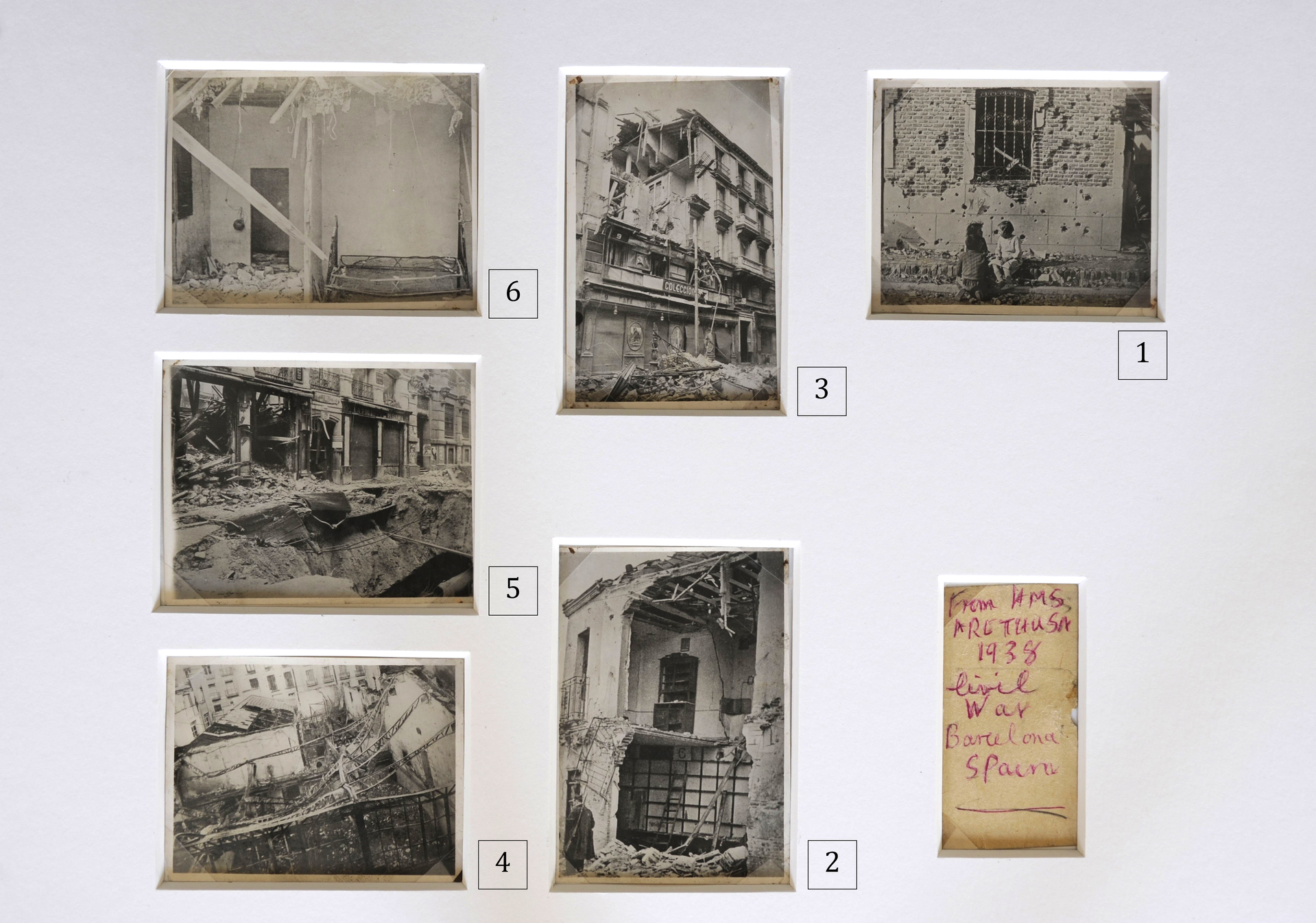
The six photographs shown in the showcase, including Robert Capa’s, arrived in the United Kingdom at the end of the Spanish Civil War, aboard the HMS (His Majesty’s Ship) Arethusa. A ship of the British Navy, based in Gibraltar, that during the war was responsible for patrolling the Mediterranean as part of the forces of the Non-Intervention Committee. The photographs were delivered by a Spanish exile to a sailor of the aforementioned ship and remained in England until 2018, when they were acquired by the collector Juan Carlos Almazán Masso, a native of Vila-real.
The photographs were accompanied by a handwritten note in English and were originally attached to a black cardboard. After a first conservation treatment, carried out by the technicians of the company Sybaria, they took off the images and installed them in a conservation framework. Subsequently, the archivists of the Documentary Center of the Anastasio de Gracia Foundation proceeded to study and identify the photographs:
— The images numbered 1 and 2 are authored by Robert Capa. The number 1 coincides with the Peironcely 10 photograph published internationally. This would be the only copy, contemporary to its author, currently preserved. The number 2 is a second shot of the upper left image published on the double page of Regards (see copy shown in the showcase), in November 1936.
— The photographs numbered 3, 4 and 5 are authored by the Spanish photographer Luis Lladó. These three copies coincide with three other images preserved in the Photographic Archive of the Propaganda Delegation of Madrid, in which the author is identified. All were taken in Madrid; the 3 corresponds to the Preciados street; 4 corresponds to the headquarters of the newspaper Informaciones, which was located on San Roque Street; and number 5 to the race of San Jerónimo.
— Photograph 6 could not be identified faithfully. By comparison with other existing images in the Chronicles of the rearguard collection, owned by José Latova Fernández-Luna, it could be from inside Peironcely 10.
— The manuscript text in English contains erroneous data, since it dates the images in 1938 and locates them in Barcelona. For all the above, it is clear that the photographs were taken in Madrid, around 1936.
— Finally, none of the photographs is a direct copy of the camera negative of their authors. All are contemporary copies at the time of taking, made from a photomechanical negative for printing. However, it has not yet been possible to identify the publication in which they were used.